Online Travel Aggregators: Business Model, Revenue, Costs
Online travel aggregators have completely transformed the way Indians plan and book their trips. Gone are the days of calling multiple travel agents or visiting airline offices. Today, millions of travellers across India — from metro cities to tier-2 towns — compare flights, hotels, buses, and holiday packages within minutes, right from their smartphones
Let's dive deep into how these platforms actually work, how they make money, and what it costs to run one.
What Is an Online Travel Aggregator?
An online travel aggregator is a digital marketplace that collects and displays travel options — flights, hotels, trains, buses, holiday packages — from multiple providers in one place. Think of it as the "Bazaar" of travel: you walk in once and compare offerings from dozens of vendors side by side.
These platforms don't own the flights or hotels themselves. They act as middlemen (or "intermediaries") connecting travellers with airlines, hotel chains, bus operators, and travel service providers.
Popular Examples in India and Globally:
MakeMyTrip -
India's largest online travel platform
Goibibo -
Major Indian OTA (Online Travel Aggregator)
Cleartrip -
Owned by Flipkart, popular for flights & hotels
Yatra.com -
One of India's oldest OTAs
EaseMyTrip -
NSE-listed Indian travel aggregator
Booking.com -
Global leader in hotel aggregation
Skyscanner -
Popular for international flight comparisons
Important Distinction
Travel aggregators compare and distribute — they don't operate aircraft or run hotels. The actual service is delivered by the airline, hotel, or operator.
How Do Online Travel Aggregators Work?
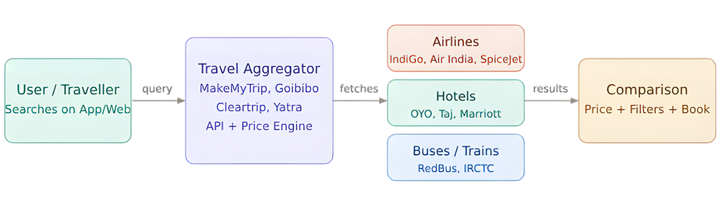
Operations of a travel aggregator can be broken down into five core functions:
Data Collection and Normalization
Airlines, hotels, and bus operators all present their pricing and availability differently. The aggregator pulls all this data and standardises it into a unified, comparable format — so a traveller in Jaipur can compare an IndiGo seat with an Air India seat on equal terms.
Real-Time Pricing via APIs
This is where the real technical muscle lies. When you click "Search Flights" on MakeMyTrip, the platform sends a live request to the APIs of dozens of airlines. Each airline's pricing engine returns its current fare instantly. This is why prices can change in seconds — it's live data, not cached rates.
Side-by-Side Comparison
Once data is normalised and live prices are fetched, the aggregator presents everything cleanly — sortable by price, duration, stops, departure time, and user ratings. This is the feature Indian travellers value most, especially for price-sensitive decisions.
Personalised Recommendations
Modern Indian OTAs now use machine learning to personalise what you see. If you frequently search for budget hotels, the algorithm learns this. Platforms like MakeMyTrip use:
- Collaborative filtering ("travellers like you booked this")
- Suitability scoring (best value, not just lowest price)
- Behavioural insights (predicting if you'd want travel insurance or cab transfers)
Booking and Lead Routing
Once a user selects a travel option, two things can happen. Either they are redirected to the airline or hotel's own website with details prefilled, or — increasingly — they complete the entire booking on the aggregator platform itself. In India, most OTAs now act as licensed travel agents (LTAs), meaning you can book end-to-end without leaving the app.
Travel aggregator facilitates the sale but does not operate the service. Claims, cancellations, and billing are ultimately handled by the airline, hotel, or operator — though OTAs increasingly help mediate these processes.
Travel Aggregator Business Models and Revenue Streams
Travel aggregators in India and globally generate revenue through multiple streams. Here's how the money flows:
Commission per Booking
Earns a fixed fee or % of booking value when a user completes a purchase. Hotels: 10–25%. Flights: ₹100–₹400 per ticket.
Lead Generation
Even if the user doesn't book, their travel intent is sold as a qualified lead to airlines, hotels, or travel insurers.
Paid Placements & Ads
Airlines & hotels pay for top-listed positions or "Sponsored" tags. Premium spots can command 15–30% markup over standard clicks.
Cross-Selling & Ancillaries
Travel insurance, cab transfers, forex cards, visa services, and holiday packages sold on top of core bookings.
Commission / CPA (Cost Per Acquisition)
This is the primary revenue source. When a traveller completes a booking, the airline, hotel, or bus operator pays the aggregator a commission. In India's competitive market, typical commissions look like this: hotel bookings fetch anywhere between 10% to 25% of the room rate, while flight commissions are slimmer — often a flat fee of ₹100 to ₹400 per ticket depending on the airline deal. Holiday packages command higher margins, sometimes 15–30% of the package value.
Lead Generation / CPL (Cost Per Lead)
Not every search results in an immediate booking. But that expressed travel intent is still valuable. Aggregators sell these warm leads to airlines, hotels, travel insurers, and even forex providers. Indian OTAs are particularly active in monetising users who search but don't immediately convert.
Featured Listings and Sponsored Placements / CPC
OYO, Marriott, IndiGo, or any travel brand can pay to appear at the top of search results with a "Sponsored" tag. This real-time auction model is similar to how Google Search Ads work. Premium top-3 placements on Indian OTAs can cost significantly more than standard listing fees, with the markup typically in the 15–30% range over base rates.
Ancillary and Cross-Selling Revenue
This is a rapidly growing stream in India. When you book a flight on MakeMyTrip, you're offered seat selection, meal preferences, travel insurance (often powered by Bajaj Allianz or ICICI Lombard), airport cab transfers, and nearby hotel deals. Each of these is a separate revenue opportunity. Some platforms also offer forex cards and visa assistance, earning referral fees from financial partners.
Subscription and Loyalty Programs
Platforms like MakeMyTrip (with MMT Black) and EaseMyTrip offer premium subscription tiers that promise better prices and priority support for a monthly or annual fee — a recurring revenue model growing in popularity across India's urban traveller segment.
Cost Structure: What Does It Cost to Run a Travel Aggregator?
Running an online travel aggregator is capital-intensive. Here's where the money goes:
Marketing and Customer Acquisition (Largest Cost)
This is, by far, the biggest expense. Indian OTAs spend aggressively on IPL sponsorships, cricket match ads, Google Search campaigns, and influencer partnerships. In highly competitive markets, customer acquisition costs (CAC) can eat up 40–70% of revenue, especially during growth phases. Google Ads for high-intent travel keywords like "cheap flights Mumbai to Delhi" or "hotels in Goa" are extremely expensive in India. TV and YouTube campaigns — think MakeMyTrip's ads with Ranveer Singh — cost crores of rupees and are essential for building brand trust in a price-sensitive market.
Technology and Platform Infrastructure
Real-time price fetching from 50+ airlines, thousands of hotels, and multiple bus/train operators simultaneously requires world-class engineering. This includes cloud infrastructure (usually AWS or Google Cloud), API integrations with hundreds of suppliers, security systems, mobile app development and maintenance, and increasingly, AI-powered recommendation and personalisation engines. As platforms scale for peak seasons like Diwali, summer holidays, and New Year, infrastructure costs spike significantly.
Supplier and Merchant Relations
Negotiating and maintaining contracts with airlines, hotel chains, bus operators, and activity providers requires large B2B sales and partnership teams. In India, where the supplier landscape is fragmented — especially in the hotel and activity segment — this is a substantial ongoing cost.
Customer Support
Indian travellers expect robust customer service, especially for cancellations, refunds, and rescheduling — which surged massively post-COVID. Most large OTAs operate multi-lingual call centres (Hindi, English, and regional languages), chatbot systems, and WhatsApp support. Cost per assisted interaction can range from ₹100 to ₹800 depending on complexity.
Regulatory and Compliance Costs
In India, travel aggregators need licences from the Ministry of Tourism (IATA accreditation for selling international air tickets), compliance with RBI norms for payment processing, GST compliance, and increasingly, data protection norms under India's Digital Personal Data Protection (DPDP) Act. Legal, compliance, and licensing form a meaningful fixed cost.
Why Travel Aggregators Matter for Indian Travellers
India's travel market is one of the fastest-growing in the world. With a rising middle class, cheaper smartphones, affordable mobile data (thanks to Jio), and UPI making payments frictionless, online travel booking has exploded. Here's why aggregators are central to this growth:
Price transparency
Indian consumers are highly price-sensitive. Aggregators put competing prices side by side, forcing airlines and hotels to stay competitive.
Convenience
One platform for flights, hotels, trains, buses, cabs, and holidays reduces the need to visit multiple booking channels.
Deals and offers
Bank cashback deals (HDFC, SBI, ICICI), wallet offers (Paytm, PhonePe), and seasonal sales (Great Indian Travel Sale) are aggregated and promoted via OTA platforms.
Vernacular access
Platforms increasingly support Hindi and regional languages, opening travel booking to tier-2 and tier-3 India.
Key Challenges Facing Indian Travel Aggregators
Thin Margins on Flights
Airlines have significantly cut commissions on domestic tickets over the years, squeezing aggregator profitability. This is why Indian OTAs now push hard on hotels, holidays, and add-ons where margins are higher.
Intense Competition
MakeMyTrip, Goibibo (now part of MakeMyTrip group), Cleartrip, Yatra, and EaseMyTrip compete aggressively, leading to heavy discounting and high marketing spends.
Dependency on Google
A significant portion of organic traffic comes via Google Search. Algorithm changes or rising CPC costs can directly impact CAC and profitability.
Trust and Refund Issues
Indian travellers have had mixed experiences with online booking refunds, especially during disruptions. Building and maintaining trust is an ongoing cost in terms of customer support and goodwill.
Final Thoughts
Online travel aggregators sit at the intersection of technology, logistics, and consumer behaviour. For Indian travellers, they have democratised access to travel options that once required physical agents or insider knowledge. For airlines, hotels, and operators, they provide a powerful, measurable distribution channel.
The business model is elegant: aggregate supply, attract high-intent demand, and monetise the connection through commissions, leads, placements, and add-ons. But it's also operationally demanding — requiring massive investment in technology, marketing, and supplier relationships before profitability scales.
As India's travel market continues to grow — expected to become one of the world's top 5 travel markets by 2030 — online travel aggregators will only become more central to how 1.4 billion Indians plan, compare, and book their journeys.